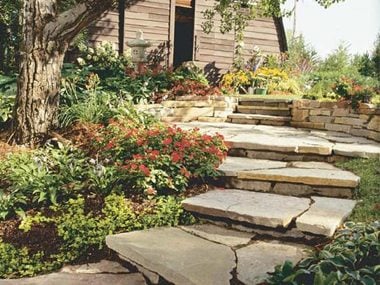
Most successful gardens have foundation plants, trees and shrubs, and ground cover, along with perennials, annuals, and vines. Here's how to choose what works best for you.

Planning your foundation plantings.Foundation plantings—the small trees and shrubs planted around the perimeter of the house—soften the straight lines of the building and ease the transition from the house to the flower bed and lawn. Choose trees and shrubs that look good year-round and won’t grow too large for the spot. Place them so they won’t grow into the house, damage the foundation with their roots, or block entrances and windows when they are mature. Evergreens work in cold climates, because they keep their foliage and color all year round; several yews in a row with a tall evergreen on the corner of the house is a timeless arrangement.Planning your trees.Before you go to the nursery, think about what you want—and don’t want—in a tree: height, width, form, bark texture and color, fruit or berries, flowers, when the tree drops its leaves and over what period of time, seasonal color and interest, disease problems, suitability to your climate, how much shade it will create when mature, pruning needs, as well as sun, soil, and water needs. A crabapple, for example, has gorgeous blossoms, but unless you choose a sterile variety, it will produce thousands of little fruits, which can litter walks and drives. Trees may be evergreen or deciduous. Evergreens are great for spots that need some green year round; deciduous trees offer more variety, changing their look with each season, and offering beautiful leaves, flowers, and fruit.Planning your shrubs.Entire gardens created with shrubs and shrub borders are low-maintenance alternatives to flower borders. When choosing a shrub, consider characteristics besides size—flower or berries; bloom time; leaf form and seasonal color; requirements for sun, soil, and water; and pruning needs. Like trees, shrubs are classified as either evergreen or deciduous. They can fill a landscape with flowers, fragrance, greenery, color, and form in a way that belies their size.Planning your ground covers.Ground covers require less maintenance than a lawn, so use these plants in areas that receive little traffic. Nearly any low-growing, spreading plant can be used for ground cover. The thicker and more vigorously a ground cover grows, the less you will need to weed the area and the less watering or other care it will need. When selecting a ground cover, consider height and spread; foliage color throughout the year; thickness of growth habit; disease resistance; soil, water, and sun needs. You will also need to find out how well the ground cover will coexist with other plants it might be near—some types of ground cover are so vigorous they choke out less aggressive plants. Top picks for ground cover include ajuga, hedera, hosta, lily-of-the valley, pachysandra, spreading juniper, and vinca.Planning your perennials and annuals.Perennials come back year after year, blooming for two weeks or even all season long, depending on the variety. They are more expensive initially, but save money over time. Annuals die after one year. They are less expensive than perennials initially, but must be replaced each year. A few begin blooming in late winter or early spring, but most bloom in mid-to late spring and provide color for months. A good local nursery will feature those that are easiest to grow in your region, but ask about sun, soil, and water requirements; how long it blooms; what the flower looks like; and any diseases or pests that threaten it. When choosing a perennial, also ask if the plant dies back in cold weather or, if not, what the foliage looks like throughout the year.Planning your vines.Vines add greenery or color to create vertical interest in your garden, and use little ground space. They're also useful in creating privacy, hiding eyesores, and making the most of a small garden. Whether you choose an annual or perennial vine, pay attention to how it will attach itself to its support. Some vines (such as morning glories, wisteria, honeysuckle) twine, others (clematis, grapes, most sweet peas) send out tendrils. Still others (such as trumpet creeper, ivies, climbing hydrangea) cling with “holdfasts” or tiny suction cups. The clinging types are somewhat permanent and are suitable only for brick, stone, and other surfaces that are virtually maintenance-free. Some vines, such as large-flowered clematis, take two or three years to attain just six to ten feet. Others, such as wisteria, grow that much in a year, reaching 40 feet or more and toppling all but the sturdiest supports.